I spent too much time as a young man obsessing over the Tour de France during the Lance Armstrong era. One moment is seared into my memory. During a mountain section, Lance was riding with Jan Ullrich when his competitor crashed. Nothing terrible; he wasn't badly injured, but it took him out of direct competition. When Lance noticed Ullrich wasn't behind him anymore, he stopped pushing. He kept looking back while coasting in the middle of the road; he unclipped his shoes and waited for the other racer to recover from his fall, repair his bike, and catch up. When Jan did catch up, Lance re-engaged and continued the race. If you want to see true sportsmanship: Tour de France 2001, Stage 13. The entire scenario played out in only a few minutes, but it stuck with me.
Watch the moment here (note: commentary includes profanity.)
This wasn't sentimentality. It was respect and strategy - brilliant strategy in the context of professional cycling's culture at that time. The game wasn't just that single stage. It was his reputation across the entire peloton, future races where he might need similar courtesy, the unwritten rules that kept the sport functioning, the respect of fans and peers. By stopping, he was playing the long game, reinforcing norms that protected everyone from random misfortune deciding outcomes. He was investing in a system where mechanical failures don't determine who wins - actual racing does.
Whatever scandals came later, the sportsmanship in that moment was real. Something has changed since then.
Everything Is a Game
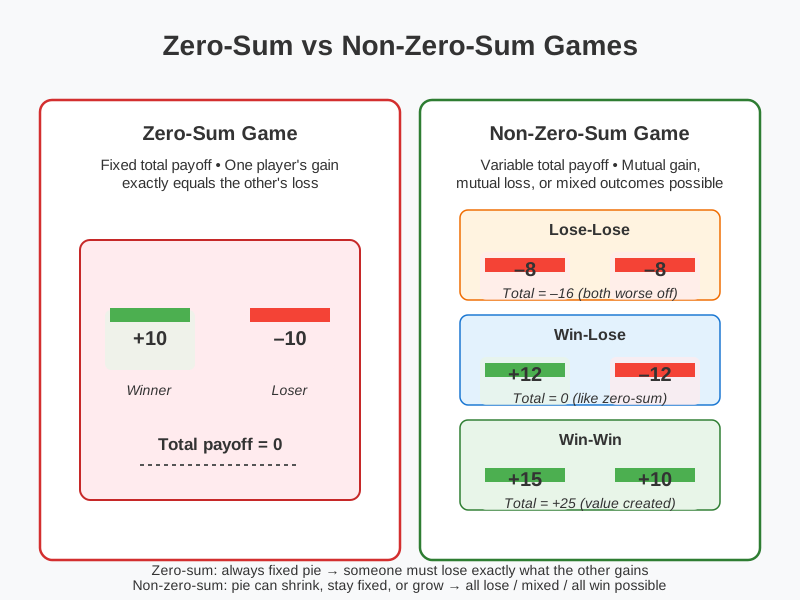
I've come to believe that every situation in life can be classified by game theory. Everything is either a zero-sum game or a non-zero-sum game. This sounds reductive, I know. But bear with me.
"Should I have coffee or tea this morning?" Solitaire has no clearly defined players, yet it's a game you can win or lose. Health reasons might dictate your beverage choice. It's a zero-sum game between you-now and you-later: will this choice hasten or delay your death?
Reading a book? Simple cost-benefit analysis. Is this book for improvement or entertainment? One will help you win by granting skills or knowledge. The other won't. You're playing against opportunity cost.
Even grief is a game. Completion of a necessary process versus avoidance and delay. Facing uncomfortable situations is the foundation of growth. Processing grief is an absolute win over resistance, even though resistance feels protective in the moment.
Sometimes the winner and loser are the same person - you give up one thing (a loss) to gain another (a win). The power of this framework isn't that it's literally true in some pedantic sense. It's that it forces clarity about tradeoffs, about what you're optimizing for, about what winning even means in the first place.
What We've Lost
As Rush lyricist Neil Peart wrote, "sometimes the winner takes nothing."
I wish I could remember the specific sporting event, but I recall a child who took off their gold medal and gave it to a competitor who had been winning but fell before finishing. Another example: a track and field race where second place carried the first place runner to the finish line and made sure he - the first place runner - crossed first. He didn't want to win against a competitor who had fallen.
These weren't irrational acts. They were investments in something more valuable than any single victory. They revealed a world where the integrity of the game mattered more than the prize, where honor in competition was the actual payoff.
For cooperation like this to be sustained, game theory tells us you need three things:
- You'll interact again - an expectation of future encounters
- Reputation matters - others observe and remember your choices
- The shadow of the future is long - future payoffs aren't heavily discounted
In the 80s, 90s, and early 2000s, good sportsmanship was elevated above winning and losing. Athletes operated in a world where all three conditions held. They'd face each other again. Their reputations preceded them. The respect of peers mattered for entire careers.
Now? All three have eroded.
Social media turned every interaction into a one-shot game with strangers you'll never see again. There's no reputation cost for scorched earth tactics because you're anonymous or dealing with people outside your actual social circle. The algorithm rewards outrage and engagement over thoughtfulness, so the payoff structure actively punishes cooperation. It's designed as a positive-sum game - network effects, idea sharing, connection - but the incentives create zero-sum status competition.
Politics and media shifted from "worthy opponent" to "existential threat." When the other side winning means catastrophe, cooperation becomes betrayal. Identity politics amplifies this by creating firm categories where your loss is definitionally my gain. The commitment to framing opponents as enemies is so ingrained as to be immutable.
Even street fights between kids have changed. They don't fight to win anymore - they do permanent damage and even kill. There is no honor in it because being honorable no longer carries value. When kids don't expect to see each other again, or when reputation is built on ruthlessness rather than restraint, the incentive to show mercy evaporates.
Respect between competitors is practically gone now. It's not enough to beat someone - you must destroy them, humiliate them, disqualify them, disgrace them.
The tragedy is that mistaking non-zero-sum games for zero-sum is catastrophically stupid strategy. You're leaving massive gains on the table. Look at social media again: I don't gain from your loss. In fact, collaboration elevates both parties. But the norm is scorched earth. Personal attacks are normal, deplatforming is normal, censorship is normal. The media is complicit in this zero-sum fixation, playing identity politics and pitting group against group.
If people could see that very few things must be zero-sum, and that non-zero-sum cooperation is much more productive, we'd all be better off.
But we can't see it. Or we won't.
The Trap
Here's what makes this particularly insidious: everyone is exhausted by it.
I'm convinced of this. Everyone is tired of the constant warfare, the performative outrage, the scorched earth tactics. But there's a group dynamic that prevents anyone from speaking the alternative. Fear of ostracism. The same destruction they wish upon their opponents will be turned on them if they defect.
This is what game theorists call preference falsification. Everyone privately disagrees with the dominant position but publicly supports it because they think they're alone. It creates a perverse equilibrium where everyone's locked into a strategy they hate.
In theory, there are three ways this could resolve:
- Option 1: A credible defector immune to punishment triggers a cascade - someone with enough status or nothing left to lose breaks ranks, revealing that most people felt the same way all along, and the equilibrium collapses overnight like the Soviet Union.
- Option 2: Coordinated simultaneous defection - enough people organize in secret and defect together, making punishment impossible.
- Option 3: System exhaustion - the energy required to maintain the warfare becomes unsustainable and people simply stop.
But these are mirages.
I thought Elon Musk buying Twitter was Option 1 unfolding in real time. He had everything required: immense status, enough wealth to be functionally immune to economic punishment, a massive platform, credibility across political lines. He was a darling of the left - environmentalists loved him because of Tesla. He seemed positioned to be exactly that credible defector who could trigger the cascade.
Instead of the equilibrium collapsing, the lines just redrew themselves around him. The left, which had celebrated him, instantly reclassified him as enemy. The mental gymnastics were able to override the shock and spectacle of his defection. Rather than his defection revealing that everyone was exhausted by the game, it became proof that he was always secretly corrupt, or had been compromised, or whatever narrative prevented anyone from examining whether he had a point. The right embraced him, but not because of some grand awakening - just because he was now on their team in the same zero-sum warfare.
No cascade. No revelation. Just a high-profile defection that got absorbed into the existing conflict, maybe even intensifying it. The system's immune response was perfect.
Option 1 requires a miracle - the right person at the right moment saying the right thing in a way that somehow bypasses the immune system. We just watched someone with every advantage fail to trigger it.
Option 2 is impossible when trust is too broken for coordination and communication itself is monitored.
Option 3 assumes exhaustion leads to peace rather than just reorganization after collapse, ignoring that commitment bias is too strong and the true believers never tire.
The trap has no exit. Which leaves only the endgame.
The Endgame
Allowing the system to reach its logical conclusion means escalation until one side wins. When there are few enough people that everyone can hear the message, maybe the alternative can be preached. Otherwise it takes a paradigm shift in an era where such shifts seem impossible.
What determines who wins in a true zero-sum fight to conclusion? Resources - who can sustain the conflict longer. Commitment - who's willing to pay higher costs. Coordination - who maintains internal cohesion under pressure. And random shocks - what unpredictable events tip the scales.
The winner might not be the best ideology or even the most popular one. Just whoever's positioned when the music stops.
The Cynical Idealist
I'm what you might call a cynical idealist. I believe things could change while simultaneously believing that they won't change.
I'd like to see the utopian Star Trek future - post-scarcity cooperation where there's enough for everyone and zero-sum resource competition becomes obsolete. But we're really heading for The Expanse: same tribal dynamics, same resource competition, same capacity for both nobility and brutality, just spread across a bigger board. The technology changes but the game stays the same.
The cynical idealist position is actually game-theoretically coherent. You play as if change is possible, because defeatism guarantees the worst outcome. But you model reality as if it won't happen, so you're not blindsided. See the clouds as potential rain. Prepare for the flood.
In your immediate sphere - family, friends, colleagues - you can still enforce iterated game norms. Build little pockets of non-zero-sum cooperation. That's not naive; it's rational self-interest in the games you actually play daily. You don't control the macro game. It plays out however it plays out.
But locally? You can still choose to stop and wait for someone to fix their flat tire.
The Clarity of the Lens
Game theory doesn't fix the problem. But it reveals the structure with remarkable clarity.
Understanding what kind of game you're in - zero-sum or non-zero-sum, one-shot or iterated, with known players or strangers - helps you choose the right strategy. It forces you to articulate what you're optimizing for, what tradeoffs you're making, what winning actually means.
Sometimes you're both players in your own game, trading off different versions of yourself or different values against each other. Sometimes the win you're chasing isn't worth having. And sometimes, as Neil Peart understood, the winner takes nothing - because refusing the unearned prize is the only way to preserve what actually matters.
I don't know if we'll rediscover that wisdom at scale. The incentive structures seem too broken, the preference falsification too entrenched, the commitment to zero-sum thinking too complete.
But I know this: one person on a bike, in the middle of a mountain road, still gets to choose whether to wait.
That choice ripples outward in ways game theory can map but never fully capture. And maybe - just maybe - enough of those ripples in enough local games is how you eventually change the macro game.
Or maybe it all burns down first and we rebuild from ashes.
Either way, I'll be here. Preparing for the flood. Hoping for rain.
