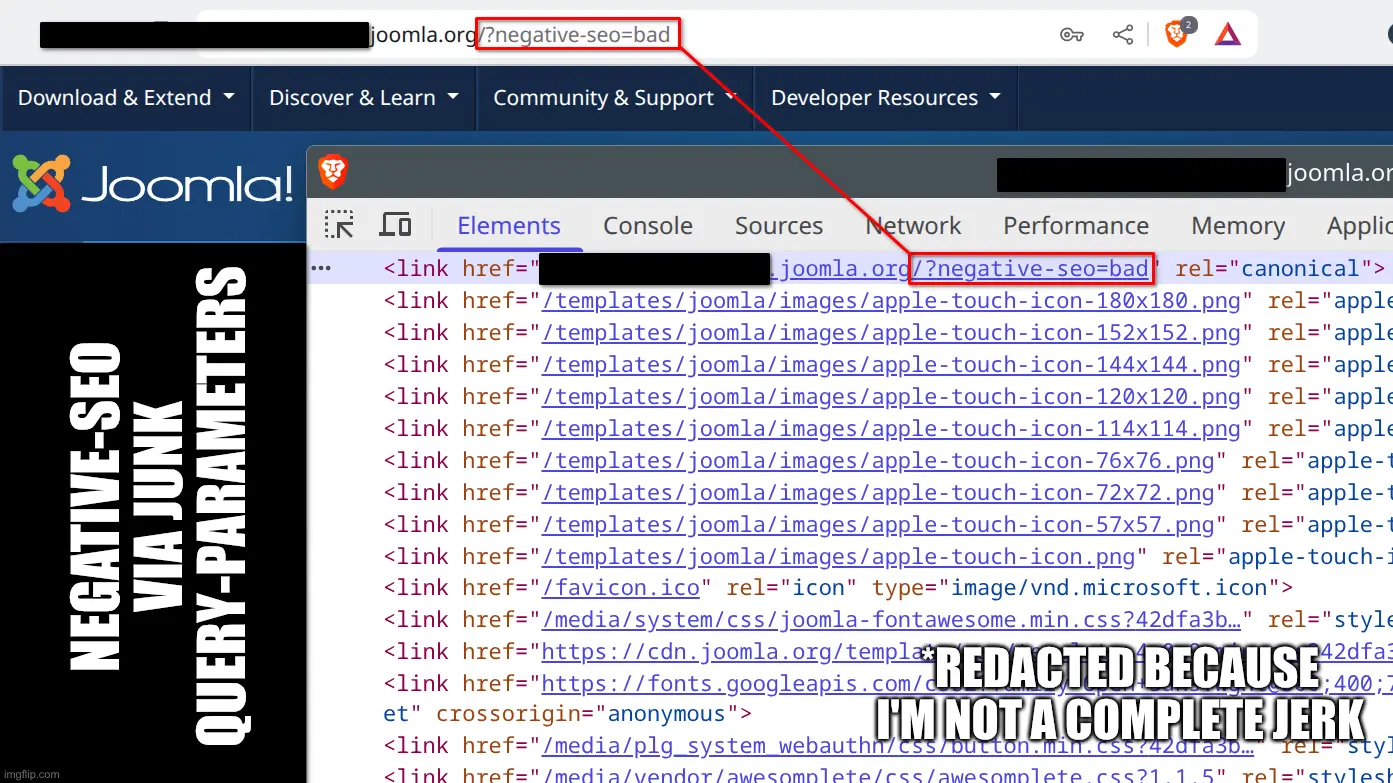
Negative SEO uses malicious tactics to sabotage a website’s search engine rankings. A dangerous method, Negative SEO via URL Parameter Abuse, exploits a flaw in Joomla’s core System - SEF plugin’s canonical URL generation, enabling attackers to create duplicate content issues that harm rankings. This canonical attack method is a real threat, and System - SEF causes it (as seen on an official Joomla site), why nearly all official Joomla sites disable the plugin (likely due to this exploit), and what RicheyWeb is doing about it - informed by SEO insights from dofollow.com.
How URL Parameter Abuse Causes Negative SEO
In this attack, malicious actors create links to your Joomla site with junk query parameters, like https://yoursite.com/article?negative=seo or ?viagra=cheap, and promote them on spammy sites to attract Google’s crawlers via injection and parameter pollution. When Joomla’s System - SEF plugin is enabled, it includes all request parameters in the <link rel="canonical"> tag, treating each link as a unique URL despite identical content. Here's an example of this type of canonical attack:
-
https://yoursite.com/article?negative=seo is indexed separately from https://yoursite.com/article.
-
This causes:
-
Duplicate Content: Splits ranking signals, reducing visibility.
-
Index Bloat: Wastes crawl budget on junk URLs.
-
Search Console Warnings: Alerts like “Google selected different canonical than user,” risking penalties.
-
This canonical attack vulnerability is not theoretical, it is a verifiable, decade-old behavior in Joomla’s core System - SEF plugin. When enabled, the plugin unconditionally appends every query parameter to the <link rel="canonical"> tag, even arbitrary junk like ?negative=seo or ?viagra=cheap, as confirmed on live official Joomla installations (specifics redacted to prevent abuse). This is not a configuration error or edge case - it is the default, documented behavior of the plugin with no built-in filtering. Independent verification is trivial: append any parameter to a page with System - SEF active, view source, and observe the polluted canonical URL. This core flaw directly enables index bloat, crawl budget waste, and for low-authority sites catastrophic deindexing, making parameter-based Negative SEO not just possible, but inevitable under targeted spam.
| High-DR Site (e.g. joomla.org) | Low-DR Site |
|---|---|
| 10,000+ URLs crawled/day | 10–50 URLs/day |
| Junk URLs = 1% of budget | Junk URLs = 50%+ of budget |
| Google ignores param spam | Google prioritizes any linked URL |
| Fast recovery | Weeks to months of damage |
Very Few Negative SEO Discussions
Would your competitors stoop so low as to cause your site negative SEO via canonical attack if they could? Of course they would, or they'd hire a shady SEO to do it for them. This low-effort attack can ruin SEO, as noted in negative SEO discussions (as on dofollow.com). The result can be achieved by hiring one of the many backlink services on sites like fiver, pushing a low value competitor URL with variations of URL query parameters. The topic is likely avoided because it's so easy to achieve but it's not so easy to solve.
System - SEF: The Canonical Attack Culprit
Joomla’s core System - SEF plugin, designed to manage canonical URLs and rewrite links in content, is the root cause of this vulnerability in its canonical generation. With no options to filter query parameters, it includes junk like ?negative=seo in canonical tags. On an official Joomla site with System - SEF enabled, adding this parameter pollutes the canonical tag, exposing the site to duplicate content risks if targeted. I've redacted the specifics to protect the site from this kind of abuse - but I thought it important to illustrate that this is a core problem which has existed for over a decade.
How Official Joomla Sites Avoid Negative SEO
Nearly all official Joomla sites disable System - SEF, likely to avoid this exploit, but lose its benefits, forcing admins to choose between SEO safety and functionality.
No Easy Canonical Attack Fix
Even if Joomla facilitated the creation of a blacklist for query variables, the list would never be long enough. The content of the query vars makes no difference to the end result - duplicate content penalties, diluted page authority, and/or Google recognizing a single canonical URL OF THEIR CHOOSING!
Why It’s Hard to Combat
URL Parameter Abuse is tough because:
-
Joomla uses legitimate parameters (e.g., id, start), obscuring malicious ones. Even a simple change to the start parameter, choosing a much-too-high number can create a duplicated page (because start=200000 is the same page as start=60).
-
Attackers can create endless variations (e.g., ?random=abc), defying manual fixes. Likewise, they can use keyword stuffing to trigger identification of what is known as "Doorway Abuse".
-
Google may prioritize malicious URLs if heavily linked, amplifying damage.
Inspiration for System - Link Canonical
As a Joomla developer practicing white-hat SEO with a focus on technical SEO, I saw System - SEF’s canonical flaw create vulnerabilities, like on an official Joomla site where ?negative=seo polluted canonicals. This, alongside other SEO issues, inspired System - Link Canonical, a lightweight plugin that lets you keep System - SEF enabled for its link management while generating smart canonicals. It whitelists valid parameters (e.g., id, start), strips junk query parameters, and caches results for performance.
This plugin stops Negative SEO via URL Parameter Abuse dead in its tracks. It intelligently filters query parameters, keeping only Joomla’s legit ones like id or start for proper functionality, while tossing out shady stuff like ?negative=seo or ?viagra=cheap that shady SEOs use to trigger duplicate content. By ensuring the canonical URL points to the clean page (e.g., https://yoursite.com/article), it prevents index bloat and keeps Google focused on your real content, all while caching results so your site stays fast.
Most important of all - it's free, because I love Joomla and I want Joomla sites to be successful.
A Canonical Attack is Preventable
Negative SEO via URL Parameter Abuse is a serious threat to Joomla sites, driven by System - SEF’s flawed canonical URL generation. Disabling the plugin avoids the exploit but sacrifices valuable link management features, creating a dilemma for site owners. Addressing this core Joomla vulnerability requires a solution that ensures SEO safety without compromising functionality. Explore how to protect your site with tools like System - Link Canonical, available free at richeyweb.com.
Negative SEO attackers create spammy backlinks with junk query parameters (e.g., ?negative=seo or ?viagra=cheap) to your pages. Joomla's System - SEF plugin blindly includes all parameters in the <link rel="canonical"> tag, creating "unique" URLs for identical content → leading to duplicate content signals, index bloat, and diluted rankings. Enable System - SEF, append a random parameter to any page (e.g., /article?test=spam), view source, and check if the polluted URL appears in the canonical tag. If yes, it's vulnerable—common on sites with SEF enabled. High-DR sites (e.g., joomla.org) may shrug off minor spam due to high crawl budgets, but low-DR sites can see 50%+ of budget wasted on junk URLs, leading to weeks/months of damage, deindexing, or spam associations. Dynamic search pages (e.g., ?searchword= or ?q=) are thin/duplicate content by nature—indexing them wastes crawl budget, risks spam association (attackers link to ?q=viagra), and creates doorway pages that trigger penalties. It's one of the fastest ways to self-inflict negative SEO signals. Always noindex them. Use robots.txt to block crawling (e.g., Disallow: /search?*), or better: use RicheyWeb's System - Meta Robots to set the robots link tag and X-Robots-Tag headers. For Smart Search/com_search, set noindex in menu item metadata or globally. Yes—with the right tool. Plugins like System - Link Canonical whitelist legitimate params (e.g., id, start for pagination), strip junk/spam ones, and generate clean canonicals while keeping SEF link management intact. High-authority sites recover quickly (days/weeks) as Google ignores minor spam. Low-authority sites face prolonged damage (weeks/months) from crawl waste and diluted signals. Clean canonicals + disavow toxic links + noindex thin pages speeds it up. No—disabling avoids the issue but loses SEF benefits (clean links). Better: Use a targeted plugin to filter params intelligently without disabling core functionality.
Yes—polluted params can duplicate across language variants (e.g., /en/article?spam=viagra vs /fr/article). Clean param handling applies universally—no extra config needed for multilingual setups.
Monitor Google Search Console for crawl errors/index bloat, use disavow tool for obvious spam links, and implement proactive param filtering. Report severe cases to Google via spam reports if needed.Frequently Asked Questions:
What is negative SEO via URL parameter abuse in Joomla?
How can I tell if my Joomla site is vulnerable to this attack?
Does this only affect low-authority sites?
Why is allowing search engines to index Joomla search result pages a bad idea?
How do I prevent search result pages from being indexed in Joomla?
Can I keep System - SEF enabled without risking this attack?
What happens if my site gets hit—how long to recover?
Is disabling System - SEF the only fix?
Does this affect multilingual Joomla sites?
How do I report or prevent ongoing attacks?
