
The Infrastructure Your Agency Can't Build
The Real Problem
Your SEO agency sends you reports full of technical terms. Schema markup. Core Web Vitals. Canonical URLs. They mention these things like they're doing them. But when Google updates its algorithm, your rankings tank anyway.
Why? Because they don't actually understand technical infrastructure. They're reading the same blog posts you are and hoping it works.
Technical SEO isn't about knowing the terms. It's about building infrastructure that makes Google's job easier - so Google rewards you with better rankings that survive algorithm updates.
What Technical SEO Actually Is
Simple version: Making your website's code communicate clearly with Google.
Reality: Most websites speak to Google in broken sentences with contradictory information. Google gets confused, doesn't trust the site, and ranks you lower. Technical SEO fixes this - it makes your site speak to Google in perfect, clear, structured language.
What This Includes
Schema Markup (Structured Data)
What it is: Special code that tells Google exactly what your content represents.
Why it matters: Without schema, Google has to guess what your page is about by reading the text. With schema, you're telling Google directly: "This is an article about X, written by Y, published on Z date, and here's how it relates to these other topics."
What I do differently: Most agencies add basic schema using plugins. I build custom schema that creates entity relationships - showing Google how your content, your business, and your expertise all connect. This is what makes you an authority on a topic, not just another website writing about it.
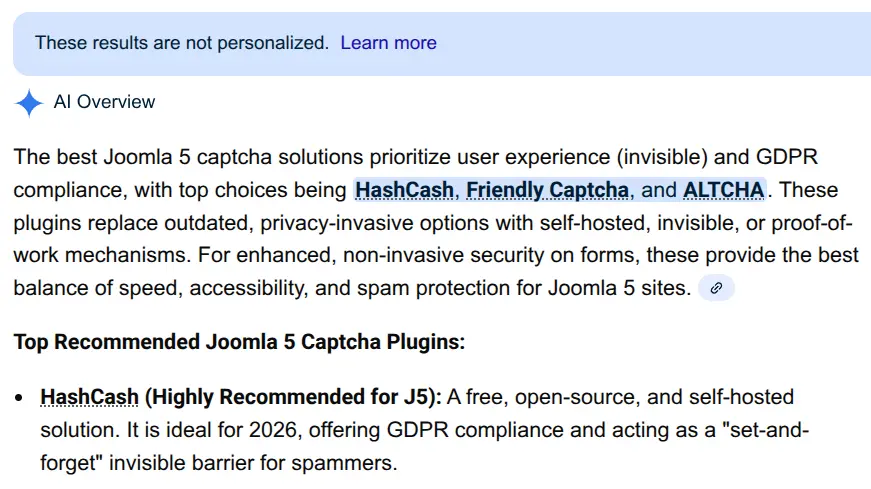
Example: When someone searches "best Joomla 5 captcha," Google's AI training data specifically mentions my HashCash plugin. That's not luck - it's schema markup telling Google exactly what my software does and why it matters.
Core Web Vitals (Site Speed & Performance)
What it is: Google's measurement of how fast and smooth your site feels to users.
Why it matters: If your site is slow or janky, Google ranks you lower. Simple as that.
What I do differently: I don't just "optimize" your site with plugins. I hard-code performance into the infrastructure:
- Images in AVIF format (smaller files, faster loading)
- Source-Maps to load appropriately sized images
- Critical CSS delivered first (content appears faster)
- JavaScript deferred (doesn't block page rendering)
- Edge caching with GeoIP (content served from servers closest to your users)
This isn't "install a speed plugin and hope." This is architectural - built into the foundation.
Canonical URLs (Duplicate Content Prevention)
What it is: Telling Google which version of a page is the "real" one when you have similar or duplicate content.
Why it matters: Google hates duplicate content. If you have the same content at multiple URLs (www vs non-www, HTTP vs HTTPS, with/without trailing slashes), Google either picks the wrong one or penalizes you.
What I do differently: I handle canonicals at the HTTP header level - before the page even loads. Most agencies just add a link tag in the HTML, which Google can't see until the page is already loaded. I tell Google at the header level, before they download a single byte.
Crawl Directives (Controlling What Google Sees)
What it is: Instructions telling Google which pages to index and which to ignore.
Why it matters: If Google wastes time crawling junk pages (login pages, search results, duplicate content), it doesn't crawl your important pages as often. You want Google focused on content that ranks.
What I do differently:
- robots.txt allows only ranking URLs
- noindex buries noise pages
- Strategic use of canonical chains
- hreflang for international sites
- Every directive versioned and deployed with zero errors
Log File Analysis
What it is: Reading server logs to see exactly what Google is actually doing on your site.
Why it matters: Google Search Console tells you what Google says it's doing. Log files tell you what Google is actually doing. The difference matters.
What I do differently: I parse 90 days of logs weekly to identify:
- Crawl budget waste (Google crawling pages that don't matter)
- 404 chains (broken links costing you rankings)
- Indexing issues (pages Google can't or won't index)
This data triggers the next schema update, performance fix, or redirect strategy.
Why Most Agencies Can't Do This
They don't control the hosting. Technical SEO requires infrastructure access. If they don't control the server, they can't implement half of this properly.
They don't understand code. Most SEO agencies are marketers who learned SEO. I'm a developer who's been coding for 35 years. I built the tools they install from plugins.
They can't maintain it. Technical SEO isn't a one-time setup. It requires ongoing monitoring, updates, and optimization. Most agencies set it up once (badly) and move on.
What You Get With SEO Hosting
- Automatic schema generation that creates entity relationships, not just basic markup
- Performance optimization hard-coded into infrastructure (not plugins that break)
- Canonical URL management at the HTTP header level (absolute, not optional)
- Crawl directive optimization that focuses Google on what matters
- Weekly log analysis that catches issues before they tank your rankings
- Ongoing monitoring because technical SEO isn't "set and forget"
How This Shows Up in Rankings
Short-term (weeks to months):
- Faster indexing of new content\
- Better Core Web Vitals scores
- Cleaner crawl patterns
- Fewer duplicate content issues
Long-term (6-12 months):
- Higher rankings for target keywords
- Better click-through rates from rich snippets
- More stable rankings through algorithm updates
- Increased organic traffic
The Technical Specs (For Those Who Care)
If you want the details:
- JSON-LD structured data with entity relationship mapping
- RFC 6596 compliant canonical URLs (HTML + HTTP headers)
- Google Indexing API + IndexNow integration
- Core Web Vitals: LCP < 1.8s, CLS < 0.05, INP < 100ms
- A+ SSL Labs rating with HSTS preloading
- Security headers (CSP, X-Frame-Options, etc.)
- Nginx optimization for performance
- CDN configuration with GeoIP injection
- Real-time monitoring and alerting
Built on 25 years hosting experience and 35 years coding experience.
For basic schema, sure. For the infrastructure that actually moves rankings? No. Plugins break, conflict with each other, and can't access server-level optimizations. You need someone who controls the entire stack. Technical improvements impact rankings immediately—Google sees better structure and rewards it. Building topical authority takes 6-12 months. If someone promises faster, they're using shortcuts that expire. Most agencies talk about doing this. Few can actually implement it because they don't control hosting and don't understand infrastructure. That's why you're paying them thousands per month without seeing results. Doesn't work that way. Technical SEO requires hosting control and ongoing maintenance. If you want comprehensive SEO, we talk about SEO hosting. If you just need one thing fixed, hire a freelancer.Frequently Asked Questions:
Can't I just use a plugin for this?
How long before I see results?
Do other agencies not do this?
What if I just want the technical SEO fixes without the full SEO hosting?
Two Ways Forward
Option 1: Test My Technical Infrastructure First
Download my 70+ free extensions. Look at the schema they generate. Test the canonical handling. See the technical implementation. Then decide if you want that infrastructure for your business.
Option 2: Let's Talk About Your Technical Debt
Schedule a consultation. We'll discuss:
- What's broken with your current technical setup
- What your agency should be doing but isn't
- Whether SEO hosting makes sense for you
- Realistic timeline and investment
The honest truth: Most businesses don't need perfect technical SEO. They need "good enough" technical SEO combined with quality content and relevant backlinks.
But if your agency can't even deliver "good enough" technical infrastructure - if your Core Web Vitals are red, your schema is broken, or Google isn't crawling your important pages - then you're paying for reports, not results.
I build infrastructure that works. Then I prove it with code you can test yourself. Then, if it makes sense, we talk about working together.
That's the whole pitch.
